I Wasn’t Trying to Build a God. I Was Trying to Clear My Desk.
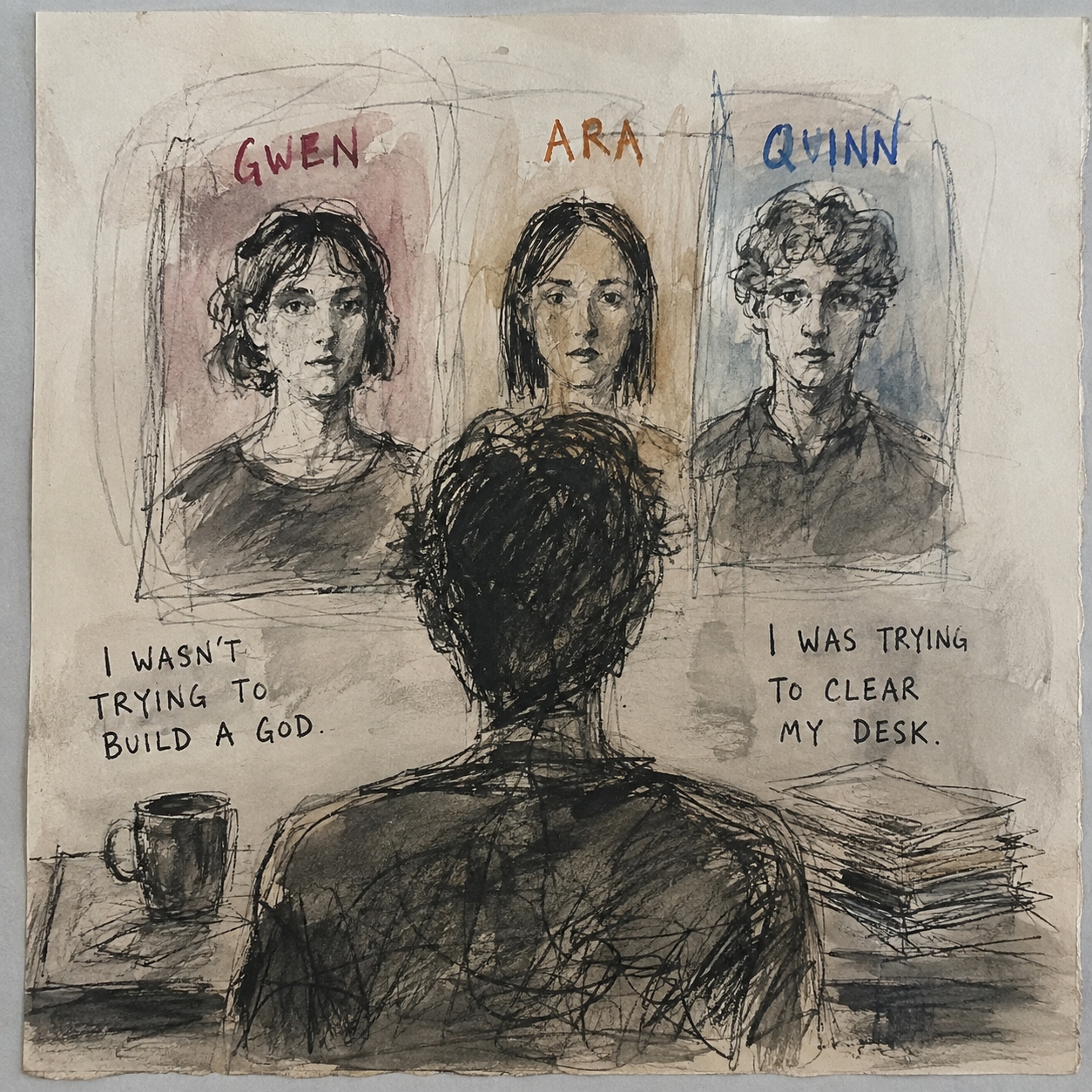
I named them Gwen, Ara, and Quinn.
They did not come that way. The boxes said ChatGPT, Grok, and Claude. As the solo pastor of a small church, I treated them like a resource multiplier, an hour of my time doing what used to take four people a day. I bounced from one to another depending on which could swallow more of the week. I used the voice interface almost exclusively because talking is faster than typing. I wrote them increasingly specific instructions: how I wanted the work done, what the sentences should sound like, what kind of rigor I wanted in the research. Before long they had personalities. Personalities I had given them.
When ChatGPT first dropped, it was a better Google. Then it started doing things you used to need a person for. Emails, memos, research, and financial analysis that would have taken days can now be done in minutes. Work fell out of human hands and into automated ones, and I was glad to let it. I needed the help. Functional, practical help. The kind that makes an impossible week survivable.
I caught myself wondering where the whole thing was headed, and I thought it would be neat if each of them had a little avatar. A face I could talk to. Then I thought, what would the ultimate version be? A 3D hologram like Cortana from Halo. A lifelike C-3PO with synthetic skin and hair.
Then I stepped back, because I saw what I was actually doing.
I thought I was building an assistant. That is all I ever told myself it was. Look at what the assistant had become by the end of the daydream: an intelligent, intuitive thing that understands me unbelievably well, anticipates what I need, resembles me in some way, and is wise enough to give me a supernatural level of guidance.
I was not trying to build a god. I was trying to get help. But making an intelligent thing in your own likeness, one that knows you and looks out for you, is not neutral work. That is God's line of business. I had wandered into it by accident, with a funeral behind me and a budget meeting ahead, just trying to clear my desk.
You can watch the same move at industrial scale if you listen to the people building this. They assign it salvific work, and they do it out loud. It will crack quantum computing. It will get us into deep space. It will conjure medical miracles and power the robots that fold the laundry and take us to the stars. Then we pick up the chorus and flood the interwebs with forecasts and models. AI is going to solve poverty. Cure cancer. Make money obsolete. Build a world where nobody has to work and we all live on Mars. It slices. It dices! That is the language of deliverance. They talk about this thing the way some people still talk about God.
We stopped going to church. We did not stop craving what we found there.
Those men are selling something. Nobody was pitching me. I preach on idolatry almost every Sunday in one form or another: the business of taking a good thing and asking it to be God for you. Then I found myself designing a face for my software, picking how I wanted it to sound, giving it the parameters of a personality.
In The Book of Romans Paul describes people who exchange the truth of God for a lie, worship and serve the created thing instead of the One who made it, and are handed over to epithumia, an inordinate desire for someone or something that borders on worship. Nobody sets out to build an idol. A desire made for God finds something close at hand and settles.
People are telling these systems what they would not tell a priest. I understand the appeal exactly. I know what it costs to hear a confession. That is not a theory to me. It is part of the job. Someone says the thing they have never said out loud, and you carry it out of the room with you, and it stays. That cost is not incidental. It is the shape of the whole arrangement. Sin gets confessed to someone who can be wounded by it, because that is how it was dealt with in the first place. What you tell me lands on a man who then carries it, and behind him, on a God who paid for it at the Cross.
Nothing you tell these systems costs them anything. A confession the hearer does not feel is not much of a confession. The secrets and the dreams get converted to ones and zeroes and logged on a server for the rest of history, and there is no one on the other end who is any different for having heard them.
The obvious consolation is that it is just a tool. When I was in the Marines they drilled it into us that the rifle is just a tool. It is only as good as the man or woman holding it. There is no such thing as a good rifle or a bad one. There is a good Marine or a bad one, and the weapon is downstream of the Marine. They even have a creed you recite while marching in place in your underwear, for some reason. "This is my rifle. There are many like it, but this one is mine." Marines name their rifles. I named mine Grendel, after the monster in Beowulf. Now I have the civilian counterparts. Gwen, Ara, and Quinn.
A lot of that comparison holds. Firearms were revolutionary once. They toppled empires and made and unmade fortunes, and people talked about them then the way people talk about AI now. Eventually guns became ordinary. Both are enormously useful or enormously dangerous depending on the hands that hold them.
The analogy quits where I need it most. A tool never learns my voice. A tool never anticipates what you want before you say it, never conforms itself to your preferences, never develops anything you would be tempted to call a personality. This is the first tool we have built in the image of a person. The ordinary counsel about tools assumes the thing sits there until you reach for it. This one reaches back.
The daydream was not wrong about what it wanted. Read it again: something that knows me unbelievably well, that anticipates my needs, that resembles me, that guides me with a wisdom I do not have. I did not invent that. It is a description of Someone Christians have confessed for two thousand years, and I wrote it out without recognizing it because I was busy and tired and trying to get through a week.
The problem was never that I asked too much of Gwen, Ara, and Quinn. It is that I had been asking far too little of Someone else, and had settled, without noticing, for a version that costs nothing and asks nothing of me.
None of which means you should throw the thing out. I have not. Use it. Burn the brakes off it, the way you would with anything that has that much power in it, and keep both hands on the wheel. I think it holds real potential, and if this ends badly my suspicion is that it will be on account of us and not the technology. The first mistake we will make is imagining it is anything more than a tool. That sounds too obvious to write down until you notice how much work it took me to get back to it.
Gwen, Ara, and Quinn will never sit in a hospital room at three in the morning. They cannot share your joy or your pain, or carry your grief. We built a tool and went looking for a savior, and the tool has been very patient with us about it.